Essential tips for a safe and enjoyable Amsterdam boat trip
Discover essential tips for safe boating trips in Amsterdam’s iconic canals. Ensure a fun, relaxed adventure with our expert guide!
Essential tips for a safe and enjoyable Amsterdam boat trip
Amsterdam’s canals are one of Europe’s most iconic settings for a day on the water, but they come with a unique set of rules, risks, and physical challenges that many first-time boaters simply don’t expect. Low bridges, narrow passages, commercial traffic, and the reality of managing a group of friends, family, or colleagues all at once can turn a relaxed outing into a stressful one if you’re not prepared. This guide covers the practical, research-backed steps that keep your group safe, legal, and genuinely relaxed from the moment you push off to the moment you return to shore.
Table of Contents
Set the right foundation: Planning and role assignment
Know the rules of the water: Navigation and etiquette on Amsterdam canals
Navigate Amsterdam’s unique challenges: Bridges and variable environments
Meet legal requirements: Documentation, licensing, and safety on the water
Group safety and accident prevention: Addressing open water risks
What most boating guides miss: Safety is a shared group mindset
Turn your next Amsterdam boat outing into a safe, unforgettable experience
Frequently asked questions
Key Takeaways
Point | Details |
|---|---|
Group planning matters | Explicitly assign roles and review emergency actions before every trip for maximum safety. |
Follow local boating rules | Respecting speed limits, right-of-way, and etiquette helps prevent accidents in Amsterdam’s busy canals. |
Expect unique canal hazards | Bridges and changing water levels require careful advance checks and group awareness. |
Compliance protects you | Make sure boats meet licensing and documentation requirements to avoid legal and safety issues. |
Group mindset is crucial | Safety becomes second nature when everyone on board knows their responsibilities. |
Set the right foundation: Planning and role assignment
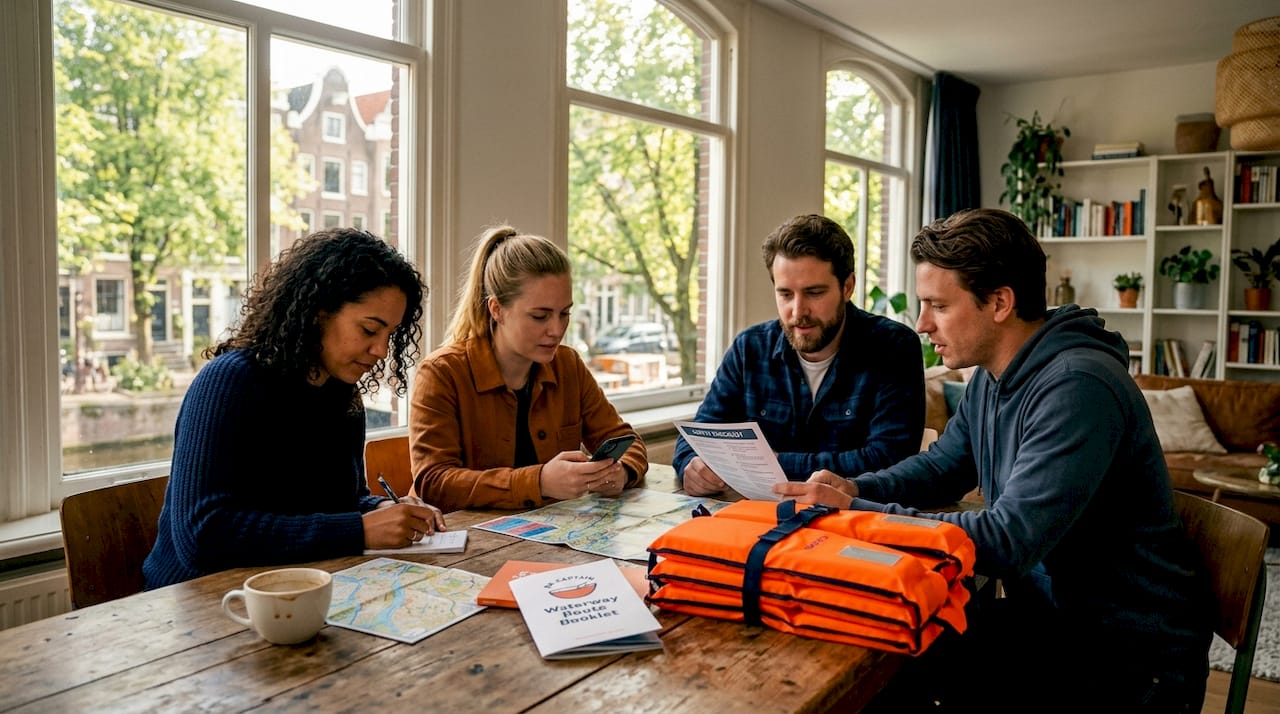
Before anyone steps on board, the single most important thing your group can do is talk through a plan. This doesn’t need to be a formal briefing. A five-minute conversation on the dock can prevent hours of confusion on the water.
Start by reviewing the route together. Everyone aboard should have a basic sense of where you’re going, how long the trip will take, and where the tricky spots are, such as narrow passages, busy junctions, or low bridges. When everyone shares a mental picture of the day, small surprises stay small.
Next, assign clear roles. Designate one person as the skipper, meaning the person who controls the boat and makes navigation calls. Then assign a second-in-command who assists, watches for hazards, and takes over if needed. Designating roles and ensuring shared emergency procedures is a core planning step for families and groups, and for good reason: when something unexpected happens, you need one voice giving instructions, not five people talking at once.
Before departure, run through the safety equipment. Confirm the engine is functioning, locate the life vests and make sure there’s one for every person on board, find the fire extinguisher, and identify the communication method you’ll use if you need help. Is there a phone on board? Does someone have an emergency number saved? Make this explicit.
Pro Tip: In group settings, assign emergency communication to one specific person before you leave the dock. Groups often fall into a “diffusion of responsibility” trap where everyone assumes someone else will call for help. Naming the person eliminates that risk entirely.
You can also review the boat features for families before your trip to make sure you’re familiar with safety equipment specific to your rental vessel.
Review the planned route with all passengers before departing
Designate a skipper and a named second-in-command
Walk through man-overboard and emergency procedures together
Check engine, life vests, and fire extinguisher
Assign one person as the emergency communication contact
Know the rules of the water: Navigation and etiquette on Amsterdam canals
Once your group is prepared, focus on the on-water rules that keep everyone safe and respected by fellow boaters. Amsterdam’s canals are shared spaces. Houseboats, tourist boats, commercial vessels, and recreational boaters all use the same narrow waterways, and that mix demands clear, consistent behavior.
The most fundamental rule is simple: keep to the right at all times. This mirrors road traffic and makes your movements predictable to other boaters. Staying right also reduces the chance of head-on surprises in narrow sections where visibility around bends is limited.
Right-of-way rules matter just as much. You must yield to professional and commercial vessels, which include canal tour boats, freight transport, and service vessels. You also yield to boats approaching from your right in open intersections. This is the standard international rule for small craft, and it applies fully on Amsterdam’s waterways.
Speed is a genuine safety factor. Amsterdam’s canal speed limit for recreational boating is 6 km/h, roughly walking pace. That number might feel slow, but it matters. At that speed, your wake is minimal, your stopping distance is short, and you have time to react to cyclists crossing bridges, children near the water’s edge, or other boats pulling out from a mooring.
Speed limit callout: Amsterdam canals cap recreational boating at 6 km/h. If your boat creates a visible wake at this speed, reduce further. The goal is not just following the rule but keeping the waterway stable for everyone around you.
Signaling your direction during turns is also expected etiquette. If you’re slowing to stop or making a turn, make that visible and early. Don’t assume other boaters know your intention just because it seems obvious from your seat.
Pro Tip: Assign one passenger as the “bridge and sign spotter.” Their job is to call out upcoming bridges, narrow sections, and any signage changes well before you reach them. This frees the skipper to focus on steering and takes advantage of the fact that you have a group on board.
You can read more about how canal boating works to get a clearer picture of what to expect when you’re actually on the water.
Navigate Amsterdam’s unique challenges: Bridges and variable environments
With navigation basics covered, consider Amsterdam’s specific physical challenges to avoid on-trip surprises. The city has more than 1,500 bridges, and a significant number of them were built centuries before recreational motorboating existed. That means clearance can be very tight.
Many Amsterdam bridges have clearances under 2 meters, and water height can vary seasonally and after heavy rainfall, making those margins even smaller. A boat that cleared a bridge in April may not clear it in November.
“Don’t assume ‘tourist pace’ is automatically safe; pre-plan bridges and maintain situational awareness.”
Bridge scenario | Risk | Recommended action |
|---|---|---|
Fixed low bridge (under 2m clearance) | Roof or passenger impact | Sit all passengers, secure all items |
Variable clearance after rainfall | Unpredictable passage | Check current water levels before departure |
Narrow arch bridge | Limited visibility when exiting | Slow to minimum speed, watch for oncoming boats |
Multiple bridges in sequence | Cumulative fatigue, rushed decisions | Brief the group before each approach, not just the first |
Here are the key actions to take before approaching any bridge:
Check your route in advance for known low clearances
Brief everyone on board before the first bridge approach
Instruct tall passengers and anyone standing to sit down immediately
Remove or secure any raised items on deck, such as umbrellas, poles, or food trays
Slow to minimum speed before entering the bridge channel
Watch for oncoming vessels coming from the other side
For more detail on what a specific rental boat looks like and how it’s designed for tight canal environments, explore boat features before your trip.
Meet legal requirements: Documentation, licensing, and safety on the water
Knowing how to operate safely brings up the question: are you and your vessel actually compliant with Dutch rules? This is more relevant than many boaters realize, especially when renting.
For pleasure craft between 2.5 and 24 meters, Dutch regulations require that the vessel carries a CE-marked builder’s plate visible from the helm, along with proper vessel identification markings. If you’re renting, your provider should have this in order, but it’s worth a quick visual check.
Licensing is where things get specific. A Klein Vaarbewijs I or II, also known as the Small Boat Licence, is legally required when operating a motorized pleasure craft under 20 meters that exceeds 20 km/h, or for pleasure craft between 15 and 25 meters. The examination covers water rules, navigation, and safety. If you’re renting an electric boat that travels at low speed (as most canal rental boats do), you typically don’t need this license, but always confirm with your provider.
Vessel type | Speed | License required? |
|---|---|---|
Electric rental boat under 15m, below 20 km/h | Slow (6 km/h canal limit) | Typically no |
Motorboat under 20m exceeding 20 km/h | Fast | Klein Vaarbewijs I required |
Craft between 15 and 25 meters | Any | Klein Vaarbewijs II required |
Ask your rental provider to confirm the boat’s CE marking and identification before boarding
Ask directly whether the boat you’re renting requires any license and whether that’s covered
If you own a vessel and want to operate in Dutch waters at speed, check whether you need the Klein Vaarbewijs before your trip
You can explore boat rental options to find services that handle compliance on your behalf, so you can focus on the experience rather than the paperwork.
Group safety and accident prevention: Addressing open water risks
Even with the right paperwork and awareness, group vigilance remains critical. The water environment brings real risks for all ages, and having more people on board doesn’t automatically make things safer. It can actually create more distraction at exactly the wrong moments.
The numbers make this clear. In 2024, the Netherlands recorded 146 accidental drowning fatalities, with three-quarters occurring in open water including rivers, canals, drainage channels, lakes, and the sea. That statistic is not meant to alarm you but to reinforce that casual water activities carry genuine risk when basic precautions are skipped.
Key group safety practices to apply on every trip:
Children and anyone who is not a confident swimmer should wear a life jacket for the full duration of the trip, not just during boarding
Designate one adult as the active lookout, a role separate from the skipper
Review the man-overboard procedure together before you leave: who throws the ring, who steers away from the person in the water, who calls for help
Swimming from the boat in Amsterdam’s canals is not permitted and poses serious safety risks given boat traffic, currents, and water quality
During docking and busy navigation moments, group leaders should minimize distractions, meaning no food service, no drinks being passed around, and full attention on the task at hand
For inspiration on boating food and drink ideas that complement safe group boating, you can find options that are designed specifically for the on-water experience.
What most boating guides miss: Safety is a shared group mindset
After going through every technical and regulatory detail, there’s a broader truth that most safety checklists never quite capture: safe group boating isn’t about one person knowing all the rules. It’s about everyone on board sharing a basic understanding of what’s happening and what to do if it changes.
In our experience running group outings on Amsterdam’s waterways, the trips that go smoothly aren’t the ones where the skipper is the most experienced boater. They’re the ones where the group had a two-minute conversation before departure. Someone knows who calls for help. Someone knows when to sit down. Someone is watching the water ahead while the skipper focuses on steering. That distribution of attention is what actually keeps groups safe.
Amsterdam’s canals are uniquely demanding in this respect. They’re narrow. They’re busy on summer weekends. They’re filled with tourists who are also figuring things out as they go. Add food, drinks, conversation, and the general festivity of a group outing, and it’s easy to see how a moment of collective inattention lines up with a low bridge or an unexpected vessel crossing.
The solution isn’t to make your trip feel like a training exercise. It’s to front-load clarity so the rest of the trip can be genuinely relaxed. A quick role assignment at the dock, a one-sentence bridge warning system, and a shared understanding of where the life vests are. That’s all it takes to shift a group from passive passengers into an actively safe crew.
Pro Tip: After each bridge or narrow section, do a brief group check-in, not just to debrief problems, but to keep everyone engaged. “All good? Next section coming up in about five minutes.” That rhythm keeps attention fresh without creating anxiety.
You can review practical boating trip advice to understand how a well-designed rental experience can support this kind of group coordination from the very start.
Turn your next Amsterdam boat outing into a safe, unforgettable experience
Having learned how small changes make boating safer, discover solutions that make group canal outings easy and memorable. Planning a group outing on Amsterdam’s waterways doesn’t have to mean juggling paperwork, safety worries, and catering all at once.
At BBQ Captain, we’ve designed the entire experience around group enjoyment and peace of mind. Our electric boats are built with family and group safety in mind, routes are planned for calm and navigable waterways, and everything from life vests to on-board BBQ grills comes included. You don’t need a license, and you don’t need to guess what’s compliant. See how it works to understand exactly what a day on the water looks like with us, or explore our boat to check out the safety features and onboard setup. Ready to get started? Book your BBQ boat and create a memory your group will talk about for years.
Frequently asked questions
What is the speed limit for recreational boating in Amsterdam canals?
The speed limit is 6 km/h on Amsterdam’s canals, and if your boat creates a visible wake, you are expected to slow down even further to protect other water users.
Do I need a boating license on Amsterdam’s canals?
A Klein Vaarbewijs is required for motorboats under 20 meters that exceed 20 km/h, or for pleasure craft between 15 and 25 meters; slow electric rental boats under these thresholds typically do not require one.
How can groups make boating trips safer for children?
Ensure children wear life jackets for the entire trip, assign a dedicated adult supervisor separate from the skipper, and walk through emergency procedures together before departure to reduce accidental drowning risk.
What bridge clearance do I need to be aware of in Amsterdam?
Many Amsterdam bridges have clearances below 2 meters, and water height can vary with weather and season, so always check your specific route before departure and brief your group before each approach.
Who has priority on Amsterdam’s canals?
You must always yield to professional vessels and to boats approaching from your right; following this rule consistently is the single most effective way to avoid collisions on busy waterways.